
News and Blogs
Building a Quality Culture Based on the Seven Principles of Management Systems
The Quality Way of Life
When organizations approach the Quality Improvement Institute of Nigeria (QIIN) for support in implementing a management system, they are often seeking something much deeper than policies, procedures, or certification. What they truly want is to build a culture, a way of thinking and working that becomes second nature to everyone in the organization.
But culture does not emerge by chance. It is shaped by principles.
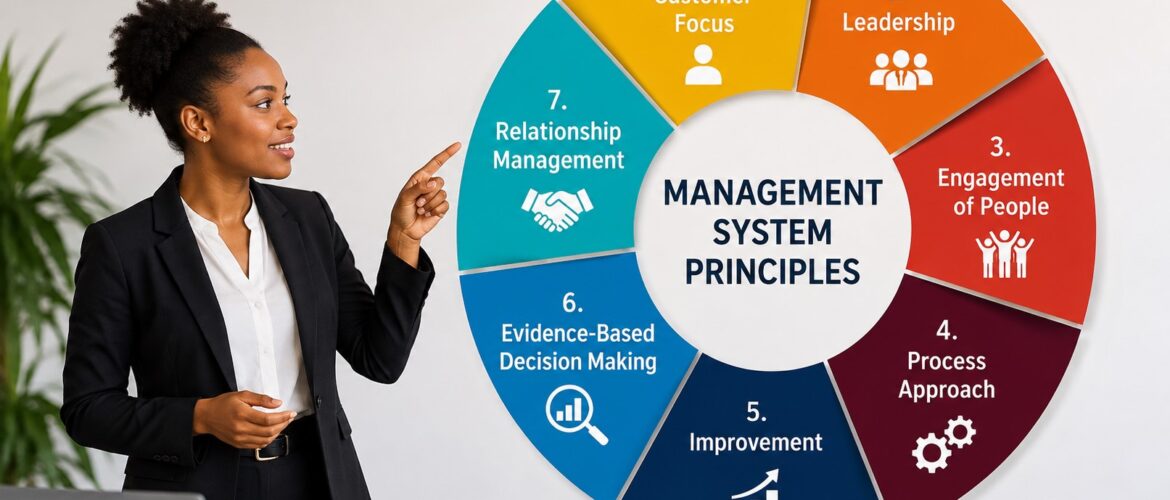
For us at QIIN, the first place to begin is with the principles of quality management, often referred to as the principles of management systems. These principles provide the foundation upon which organizations develop behaviours, make decisions, engage people, and pursue excellence. More importantly, they offer a common language that every individual in the organization (from top management to frontline staff) can understand and embrace.
A truly effective management system is one in which these principles are not merely written in manuals or displayed on office walls, but are reflected in everyday actions and decisions.
1. Customer Focus: The Reason Every Organization Exists
Every organization exists because of its customers. Whether they are called customers, patients, passengers, students, or clients, they are the reason organizations exist and grow.
Customer focus goes beyond simply meeting expectations; it means deliberately placing the customer at the centre of decisions, products, and services.
Some organizations have taken this principle to extraordinary levels by involving customers in major decisions, including changes to their brand identity and logo. Imagine an organization asking its customers, “We are redesigning our logo, what do you think?” That is customer focus in action.
Organizations that truly understand this principle constantly ask:
- What do our customers need?
- How do they perceive our services?
- What changes can we make to improve their experience?
An organization that loses sight of its customers eventually loses sight of its purpose.
2. Leadership: Responsibility and Accountability at Every Level
When people hear the word leadership, they often think of presidents, chief executives, or directors. In reality, management systems teach us that leadership exists at different levels.
Yes, top management provides strategic direction, establishes policies, and allocates resources, but leadership goes far beyond titles and positions.
At QIIN, we describe leadership as taking responsibility and being accountable for the tasks assigned to you.
Every individual is a leader within the scope of their responsibilities. A receptionist who ensures that customers are treated respectfully is demonstrating leadership. A laboratory scientist who follows procedures and reports errors honestly is demonstrating leadership. A supervisor who supports their team is demonstrating leadership.
Leadership is not simply a position; it is a commitment to responsibility and accountability.
3. Engagement of People: Carrying Everyone Along
No management system can succeed if it belongs only to a few individuals.
Too often, organizations send two staff members out of twenty for training and expect those two individuals to carry the entire burden of implementation. Months later, when management asks, “Why is the quality management system not working?” everyone points fingers at the two people who attended the training.
That is not engagement.
Engagement of people means involving everyone in the journey. It means ensuring that knowledge is shared, responsibilities are understood, and people feel that they are part of the process.
When people are engaged, they do not see quality as someone else’s responsibility, they see it as our responsibility.
4. Process Approach: Understanding How Work Flows
Organizations achieve better results when they understand that work is not a collection of isolated activities but a network of interconnected processes.
A process approach encourages organizations to ask important questions:
- What makes a process (Inputs, Activities and Output)
- What activities create value?
- How do different departments interact?
- Where do delays, risks, and inefficiencies occur?
When organizations begin to see how one process affects another, they improve coordination, reduce waste, and create consistency.
Great organizations do not manage tasks in isolation; they manage processes as part of a larger system.
5. Improvement: Change Is the Driver of Progress
At QIIN, improvement is at the heart of everything we do.
However, improvement is often misunderstood. Many people look at a 20% increase in performance and call it improvement. In reality, that increase is merely a measure of improvement.
The real improvement lies in what changed to make that increase possible.
New ideas, modified processes, better communication, staff development, technological innovations, and improved methods, these are the drivers of improvement.
The truth is simple: improvement cannot happen without change.
Organizations that resist change inevitably resist improvement. Those that embrace change create opportunities to grow, adapt, and perform better.
6. Evidence-Based Decision Making: No Decision Without Science
In many organizations, decisions are sometimes influenced by assumptions, emotions, or personal opinions.
Management systems challenge that approach.
At QIIN, we often say:
“Do not take a decision without science.”
Evidence-based decision making means relying on facts, data, observations, measurements, and objective evidence to guide actions.
Questions such as:
- What does the data say?
- What trends can we observe?
- What evidence supports this decision?
help organizations reduce uncertainty and make better choices.
Good decisions are not driven by intuition alone; they are supported by evidence.
7. Relationship Management: Communication Is the Real Driver
Organizations do not operate in isolation. They depend on customers, suppliers, regulators, employees, partners, and the communities they serve.
But at QIIN, we believe that the true driver of relationship management is effective communication.
Strong relationships depend on communication that is:
- Timely
- Respectful
- Clear
- Honest
- Continuous
Whether communicating with customers, suppliers, or internal teams, organizations that communicate effectively build trust, strengthen relationships, and create long-term value.
Without communication, relationships weaken. With effective communication, relationships flourish.
Beyond Certification
The seven principles of management systems are much more than requirements for certification. They are practical guides for building organizations that people trust, systems that perform, and cultures that endure.
When these principles become part of everyday thinking, when customer focus shapes decisions, leadership inspires responsibility, people are engaged, processes are understood, improvement is embraced, evidence guides decisions, and communication strengthens relationships, quality stops being a project.
Click Here to register for our upcoming ISO Certification Courses.