
News and Blogs
ISO 19011:2026 — What Every Auditor Must Know
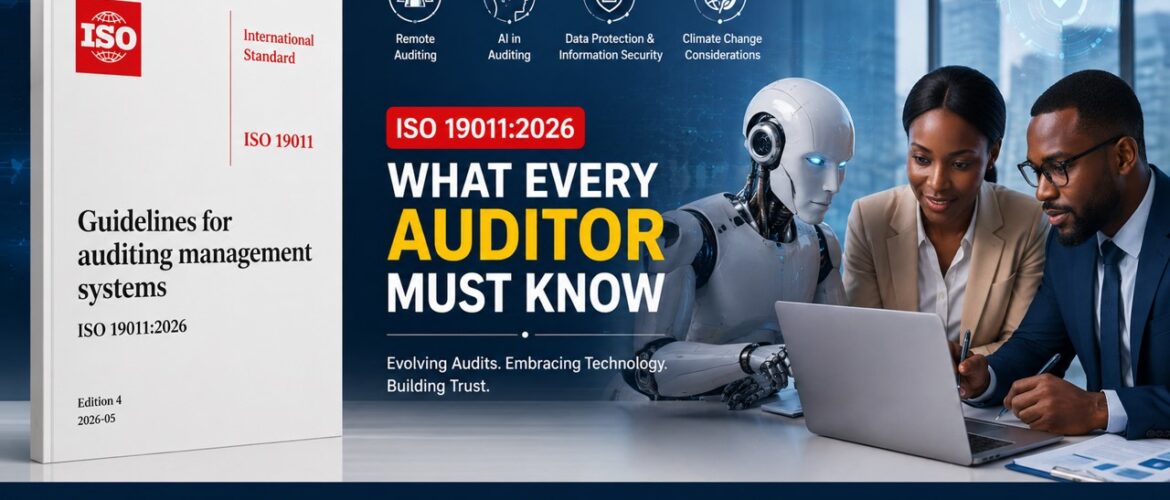
The Future of Auditing Is Already Here
ISO 19011:2026 officially arrived on May 27, 2026, interestingly, on Children’s Day in Nigeria. Yet, for auditors and management system professionals, this is certainly no child’s play.
Even more interesting for me personally was the timing.
I was right in the middle of facilitating an Internal Auditor Certification Course when the news of the publication emerged. As we discussed audit principles, audit evidence, audit programmes, nonconformities, and auditor competence, the auditing world itself was evolving in real time.
And although ISO 19011 remains a guidance standard rather than a certifiable requirements standard, the changes introduced in the 2026 edition will significantly influence how audits are planned, conducted, reported, and followed up.
From remote auditing and artificial intelligence to auditor competence, audit programme risks, and the ethical handling of nonconformities, the new edition reflects the realities of modern auditing.
The question is no longer whether auditing is changing.
The question is:
Are auditors changing with it?
First, What Is ISO 19011?
ISO 19011 is the internationally recognized guidance standard for auditing management systems. It provides direction for organizations and auditors on how audits should be planned, managed, conducted, and improved.
Unlike ISO 9001 or ISO 15189, ISO 19011 is not a standard organizations get certified against. Instead, it shapes how internal audits, supplier audits, and even many certification audit approaches are performed.
In simple terms:
If ISO standards tell organizations what to implement, ISO 19011 helps auditors determine how to audit it properly.
So, What Has Changed?
At first glance, some changes may appear small — wording updates, clause restructuring, revised terminology.
But beneath those edits lies a deeper shift.
ISO 19011:2026 recognizes that auditing is no longer confined to conference rooms, paper records, and physical site visits.
Auditing is becoming increasingly digital, remote, technology-enabled, and risk-driven.
Remote Auditing Is No Longer an Emergency Option
One of the biggest themes in the new edition is the expansion of guidance on remote auditing methods and virtual audit locations.
For years, many organizations viewed remote audits as temporary arrangements introduced during COVID-19 disruptions.
That mindset is now outdated.
ISO 19011:2026 formally expands guidance around remote auditing and even references ISO/IEC TS 17012:2024 for further direction on using remote auditing methods.
This means auditors must now become more competent in:
- virtual communication,
- remote evidence verification,
- digital records review,
- and technology-supported auditing methods.
The modern auditor may now audit a process occurring hundreds of kilometers away — without physically stepping into the facility.
Artificial Intelligence Has Entered the Audit Conversation
Perhaps one of the most interesting developments is the recognition of emerging technologies, including AI-based evaluation tools.
The standard now expects auditors to understand:
- the appropriateness of emerging technologies,
- the consequences of using such technologies,
- and even how to audit processes that themselves rely on emerging technologies.
This is significant.
It means the future auditor will require more than checklist skills and clause memorization.
Auditors must now think critically about:
- digital systems,
- information security,
- data protection,
- automated tools,
- and technology-related risks.
The audit profession is evolving from traditional compliance checking into technology-aware assurance.
Internal Audit Is Still “Us on Us”: But Bias Must Be Managed
One subtle but important change relates to auditor independence.
The previous edition stated that internal auditors should be independent of the function being audited “if practicable.”
The revised edition removes this exact wording but emphasizes that where full independence is difficult, organizations must still make every effort to remove bias and encourage objectivity.
This is particularly relevant for smaller organizations where individuals often perform multiple roles.
The message is practical:
Perfect independence may not always be possible.
But fairness, objectivity, and integrity must still remain non-negotiable.
Ethical Auditing: Nonconformities Should Never Be Surprises
Another excellent reminder in ISO 19011:2026 is that nonconformities that were not discussed during the audit or closing meeting should not suddenly appear inside the final audit report.
This strongly reinforces ethical auditing practices.
Auditing should never become:
- witch-hunting,
- fault-finding,
- or surprise reporting.
Good auditing is transparent.
At QIIN, we often teach that auditors are not supposed to “go looking for nonconformities.” Instead, auditors go to verify conformance.
Only when conformance cannot be demonstrated through objective evidence does a nonconformity emerge.
That philosophy remains deeply relevant in the 2026 edition.
The Auditor of the Future
ISO 19011:2026 may not be revolutionary in appearance, but it is clearly evolutionary in direction.
The modern auditor is gradually becoming:
- more technology-aware,
- more risk-focused,
- more evidence-driven,
- more ethical,
- and more adaptable to digital environments.
Auditors who refuse to evolve may soon struggle to remain effective in increasingly complex systems.
Final Reflection
The release of ISO 19011:2026 during an Internal Auditor training session felt symbolic to me.
It was a reminder that quality professionals and auditors must remain continuous learners themselves.
Because auditing is no longer just about asking:
“Are procedures available?”
It is increasingly about asking:
“Can this system still be effectively audited in a digital, remote, AI-enabled, risk-driven world?”
And perhaps that is the real message behind ISO 19011:2026.
The future of auditing has already started.
The question now is:
Will auditors evolve with it?